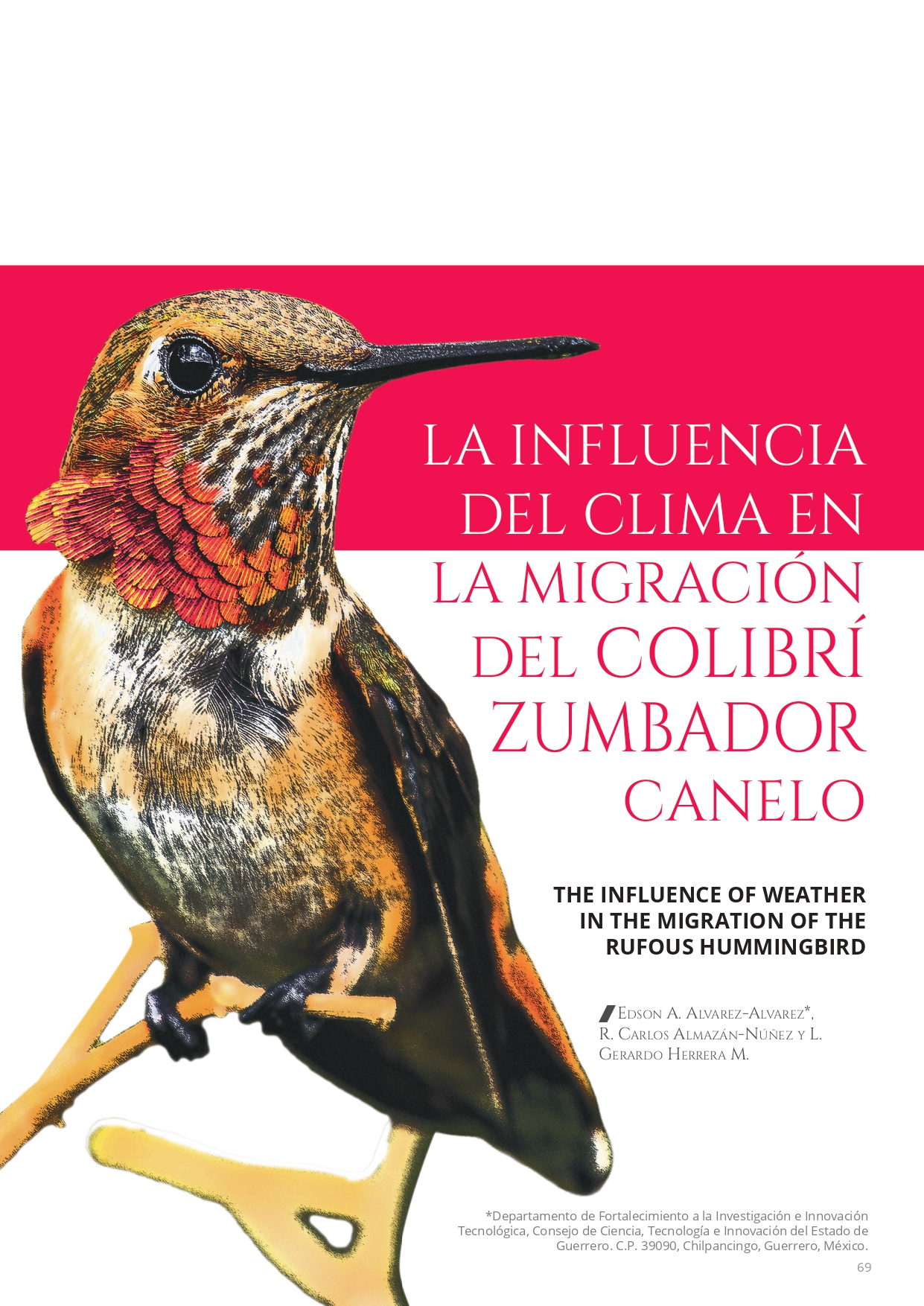
The influence of weather in the migration of the Rufous Hummingbird
DOI:
https://doi.org/10.29105/bys9.17-229Keywords:
wintering area, reproductive area, seasonality, Selasphorus rufus, North AmericaAbstract
13 hummingbird species are considered migratory; that is, they breed in certain regions and winter in others, traveling between different geographic areas across North America. During these journeys, hummingbirds encounter climatic variations that impact their migration and distribution patterns. This is particularly true for the Rufous Hummingbird (Selasphorus rufus), a near-threatened species that breeds in the United States during spring and summer, and winters in the south-central Mexico, southeastern-northeastern United States, and southeastern Canada during fall and winter. In this contribution we documented the climatic conditions under which this species develops in its breeding and wintering areas using ecological niche and species distribution models. Some common climatic variables such as temperature, precipitation, and solar radiation, allow us to characterize the ecological niches of species. Once these niches are characterized, we can project their geographic distribution. However, climate change and habitat loss, driven by human activities, could alter the migration patterns and distribution areas of the Rufous Hummingbird.
Downloads
References
Alvarez-Alvarez, E.A. R.C. Almazán-Núñez, F.A. Toro-Cardona, L.G.M. Herrera, M.J. Tolsá-García, O. Talavera-Mendoza, M. Lopezaraiza-Mikel. En prensa. Seasonal climatic niche-switching migration in the Nearctic-Neotropical Rufous Hummingbird (Selasphorus rufus). PloSONE. https://doi.org/10.1371/journal.pone.0334958
Gillespie, C.R., S. Contreras-Martínez, C.A Bishop, J.D. Alexander. 2020. State of the Rufous Hummingbird science and conservation. Western Hummingbird Partnership, Colorado, 23 pp.
Haest, B., O. Hüppop, F. Bairlein. 2018. The influence of weather on avian spring migration phenology: What, where and when? Global Change Biology. 24(12): 5769–5788. https://doi.org/10.1111/gcb.14450
Healy, S. y W.A. Calder. 2020. Rufous Hummingbird (Selasphorus rufus). En: AF Poole, (Ed.) Birds of the World (Version 1.0). Cornell Lab of Ornithology. https://doi.org/10.2173/bow.rufhum.01 (consultado el 20/07/2025).
Hernández-Hernández, N., C. Mota-Vargas, C. Lara, O. Rojas-Soto. 2022. Seasonal distribution of the Broad-Tailed Hummingbird (Selasphorus platycercus): a climatic approach. Zoological Studies. 61: 23. https://doi.org/10.6620/ZS.2022.61-23
Jefferys, K.M., M.G. Betts, W.D. Robinson, J.R.F. Curtis, T.A. Hallman, A.C. Smith, C. Strevens, J. Aguirre-Gutiérrez. 2024. Breeding habitat loss linked to declines in Rufous Hummingbirds. Avian Conservation and Ecology. 19(2): 2. https://doi.org/10.5751/ACE-02681-190202
Mota-Vargas, C., A. Encarnación-Luévano, H.M. Ortega-Andrade, D.A. Prieto-Torres, A. Peña-Peniche, O.R. Rojas-Soto. 2019. Una breve introducción a los modelos de nicho ecológico. Pp. 39–63. En: Moreno C.E. (Ed.). La biodiversidad en un mundo cambiante: Fundamentos teóricos y metodológicos para su estudio. Universidad Autónoma del Estado de Hidalgo/Libermex, Ciudad de México, 383 pp.
Nemes, C.E., S.A. Cabrera-Cruz, M.J. Anderson, L.W. DeGroote, J.G. DeSimone, M.L. Massa, E.B. Cohen. 2023. More than mortality: Consequences of human activity on migrating birds extend beyond direct mortality. Ornithological Applications. 125(3): duad020. https://doi.org/10.1093/ornithapp/duad020
Ríos-Muñoz, C.A., M. Vega-Flores, K.M. Vega-Flores, S. Hernández-Rubio, D.V. Espinosa-Martínez. 2021. Del concepto a su aplicación: el proceso del modelado de nichos ecológicos y sus algoritmos. Revista Latinoamericana de Herpetología. 04(01): 11–25.
Rushing, C.S., J.A. Royle, D.J. Ziolkowski Jr., K.L. Pardieck. 2020. Migratory behavior and winter geography drive differential range shifts of eastern birds in response to recent climate change. Proceedings of the National Academy of Sciences. 117(23): 12897–12903. https://doi.org/10.1073/pnas.200029911
Somveille, M., A.S.L. Rodrigues, A. Manica. 2015. Why do birds migrate? A macroecological perspective. Global Ecology and Biogeography. 24(6): 664–674. https://doi.org/10.1111/geb.12298
Schondube, J.E., S. Contreras-Martínez, I. Ruan-Tejeda, W.A. Calder, E.C. Santana. 2004. Migratory patterns of the Rufous Hummingbird in western Mexico. Pp. 80–95. En: Nabhan G.P. (Ed.). Conserving migratory pollinators and nectar corridors in Western North America. University of Arizona Press, Arizona, 191 pp.
Supp, S.R., F.A. La Sorte, T.A. Cormier, M.C.W. Lim, D.R. Powers, S.M. Wethington, S. Goetz, C.H. Graham. 2015. Citizen-science data provides new insight into annual and seasonal variation in migration patterns. Ecosphere. 6(1): 15. https://doi.org/10.1890/ES14-00290.1
Thorup, K., A.P. Tøttrup, M. Willemoes, R.H.G. Klaassen, R. Strandberg, M.L. Vega, H.P. Dasari, M.B. Araújo, M. Wikelski, C. Rahbek. 2017. Resource tracking within and across continents in long-distance bird migrants. Sciences Advances. 3(1): e1601360. https://doi.org/10.1126/sciadv.1601360
Downloads
Published
How to Cite
Issue
Section
Categories
License
Copyright (c) 2026 Edson A. Alvarez-Alvarez, R. Carlos Almazán-Nuñez, L. Gerardo Herrera M.

This work is licensed under a Creative Commons Attribution 4.0 International License.