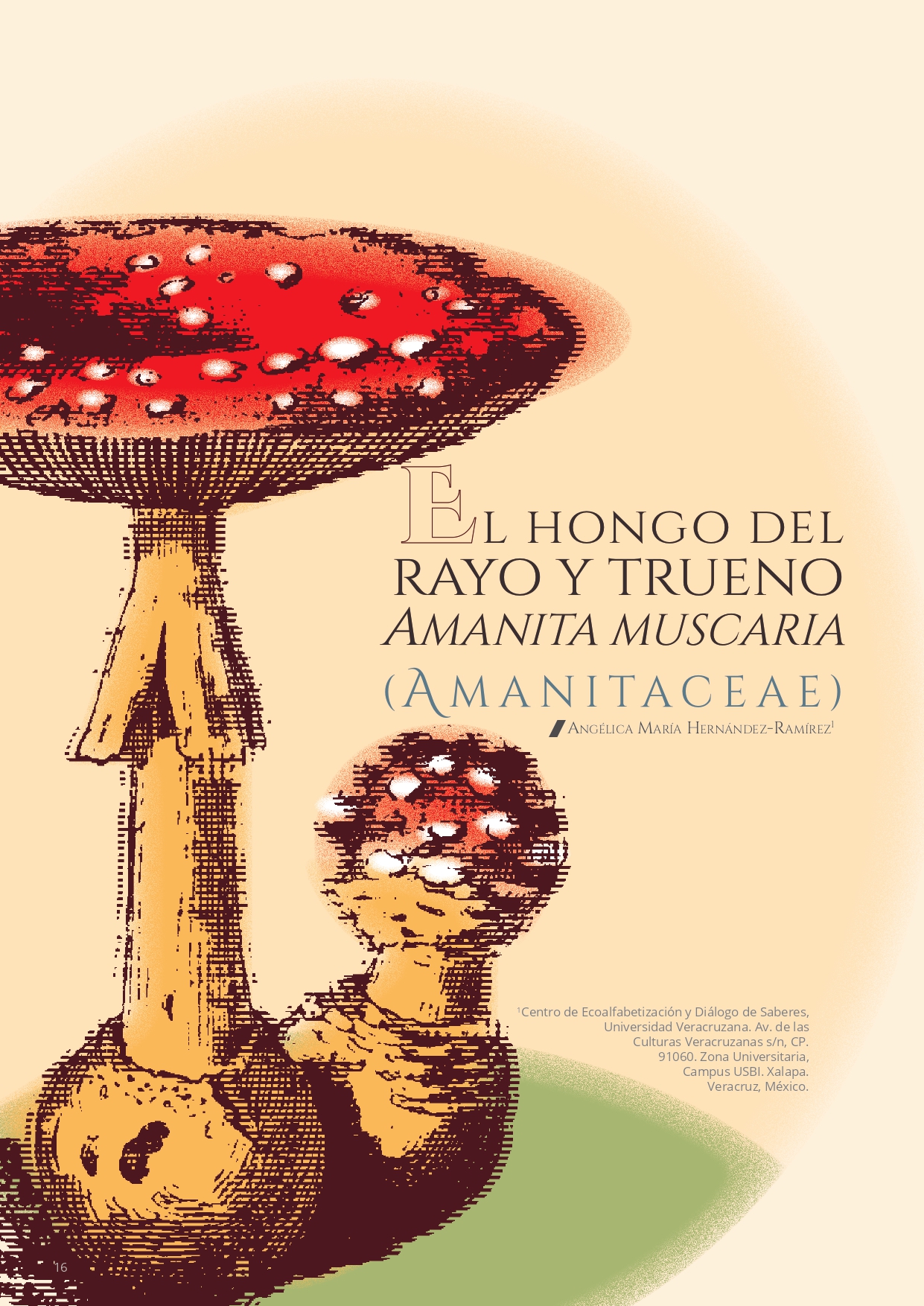
El hongo del rayo y trueno Amanita muscaria (Amanitaceae)
DOI:
https://doi.org/10.29105/bys9.18-265Palabras clave:
hongo del trueno, Amanita muscaria, manejo seguro, conocimientos ancestrales y tradicionalesResumen
Amanita muscaria (L.) Lam. es un hongo icónico con una alianza mágica con el rayo. Se expandió por tres rutas principales desde su población ancestral, mientras que su vínculo ancestral con los seres humanos lo ha hecho sagrado, por lo que ha sido representado en Códices y piezas antiguas de México. Posee propiedades psicotrópicas y sustancias tóxicas, lo que ha provocado efectos adversos a la salud humana llamados micetismos, aunque la vigilancia epidemiológica de su toxicidad por consumo incidental sigue siendo escasa. A pesar de ello, los conocimientos y prácticas tradicionales han facilitado su consumo y el comercio en los mercados locales de México. No obstante, las prácticas de recolección de hongos cada vez son más escazas y los saberes tradicionales relacionados a la identificación de hongos comestibles y tóxicos se han ido perdiendo. Este estudio presenta una breve aproximación al conocimiento de Amanita muscaria y la importancia de los conocimientos tradicionales vinculados a su preparación que lo hace un hongo seguro para el consumo humano.
Descargas
Citas
Bautista-González, J.A. 2013. Conocimiento tradicional de hongos medicinales en seis localidades diferentes del país. Tesis de Licenciatura, Facultad de Ciencias Biológicas, Universidad Nacional Autónoma de México, 144pp. https://repositorio.unam.mx/contenidos/405256
Brvar M., M. Mozina, M. Bunc. 2006. Prolonged psychosis after Amanita muscaria ingestion. Wien Klin Wochenschr. 118: 294–297. https://doi.org/10.1007/s00508-006-0581-6
Caamal-Caamal, L.G., A. Montoya, L. Trejo-Hernández, C. Castillo-Guevara. 2017. Estado del arte relativo al conocimiento tradicional de los hongos silvestres en el estado de Tlaxcala, México. Mexican Journal of Biotechnology. 2(1): 1-14. https://doi.org/10.29267/mxjb.2017.2.1.1
Carboué, Q., M. Lopez. 2021. Amanita muscaria: ecology, chemistry, myths. Encyclopedia. 1(3): 905-914. https://doi.org/10.3390/encyclopedia1030069
Caroll L. 1865. Alice in Wonderland. United Kingdom.
Contreras Cortés, L.E.U., A. Vázquez García, F. Ruan-Soto. 2018. Etnomicología y venta de hongos en un mercado del Noroeste del estado de Puebla, México. Scientia fungorum. 47: 47-55. https://www.scielo.org.mx/scielo.php?pid=S2594-13212018000100047&script=sci_arttext
De Borhegyi, C., Y.S. de Borhegyi-Forrest. 2013. The genesis of a mushroom/venus religion in Mesoamerica. PP. 451–518. En Rush J. A. (Ed.). Entheogens and the development of culture. Berkeley: North Atlantic Books, 672pp.
De Borhegyi, S.F. 1961. Miniature mushroom stones from Guatemala. American Antiquity. 26: 498–504. http://www.jstor.org/stable/278737
Festi, F. 1985. Funghi allucinogeni: aspetti psicofisiologici e storici. [Hallucinogenic mushrooms. Psychophysiological and historical aspects] LXXXVI [Publication No. 86] Museo Civico di Rovereto, Rovereto, Italy.
Geml, J., G.A. Laursen, K. O'Neill, H. C. Nusbaum, D.L. Taylor. 2006. Beringian origins and cryptic speciation events in the fly agaric (Amanita muscaria). Molecular Ecology, 15(1): 225-239. https://doi.org/10.1111/j.1365-294X.2005.02799.x
Gobierno de México. 2024. Sistema Nacional de Vigilancia Epidemiológica. Gobierno de México. https://www.gob.mx/salud/ (consultado el 17 diciembre 2024).
Guzmán, G. 2016. Las relaciones de los hongos sagrados con el hombre a través del tiempo. Anales de antropología. 50: 134-147. https://doi.org/10.1016/j.antro.2015.10.005
Jarvis, M. C., A. M. Miller, J. Sheahan, K. Ploetz, J. Ploetz, R. R. Watson, M. P. Ruíz, C. A. P. Villapan, J. G. Alvarado, B. Orr, B. 2004. Edible wild mushrooms of the Cofre de Perote region, Veracruz, Mexico: An ethnomycological study of common names and uses. Economic Botany. 58(1): S111-S115. https://doi.org/10.1663/0013-0001(2004)58[S111:EWMOTC]2.0.CO;2
Lara-Vázquez, F., A.T. Romero-Contreras, C. Burrola-Aguilar. 2013. Conocimiento tradicional sobre los hongos silvestres en la comunidad otomí de San Pedro Arriba; Temoya, Estado de México. Agricultura, sociedad y desarrollo. 10(3): 305-326. https://www.scielo.org.mx/scielo.php?script=sci_arttext&pid=S1870-54722013000300003
Lowy, B. 1974. Amanita muscaria and thunderbolt leyend in Guatemala and Mexico. Mycologia 66: 188-190. https://doi.org/10.2307/3758472
Mapes, C., G. Guzmán, J. Caballero. 1981. Entomología Purépecha. El conocimiento y uso de los hongos en la cuenca del lago de Pátzcuaro, Michoacán. Dirección General de Culturas Populares, Sociedad Mexicana de Micología A.C., Instituto de Biología, UNAM, México.
Michelot, D., L.M. Melendez-Howell. 2003. Amanita muscaria: chemistry, biology, toxicology, and ethnomycology. Mycological research. 107(2): 131-146. https://doi.org/10.1017/S0953756203007305
Moreno-Fuentes, A. 2002. Estudio etnomicológico comparativo entre comunidades Rarámuris de la Alta Tarahumara en el estado de Chihuahua. Tesis Doctorado en Ciencias, Facultad de Ciencias Biológicas, Universidad Nacional Autónoma de México. 277pp. https://hdl.handle.net/20.500.14330/TES01000307801
Oda, T., C. Tanaka, M. Tsuda. 2004. Molecular phylogeny and biogeography of the widely distributed Amanita species, A. muscaria and A. panthenna. Mycological Research, 108(8): 885-896. https://doi.org/ 10.1017/S0953756204000620
Ott, J. 1978. Recreational use of hallucinogenic mushrooms in the United States. PP. 231-243. Rumack, H. & E, Salzman (eds.). Mushroom poisoning, diagnosis and treatment. CRC Press, West Palm Beach. 464pp. https://www.cabidigitallibrary.org/doi/full/10.5555/19781349252
Ramírez, G.P., D.L.P. Sánchez, M.H. Hernández, R.R. Ramírez. 2020. Revisión histórica de los hongos psilocibios. Educación y Salud Boletín Científico Instituto de Ciencias de la Salud Universidad Autónoma del Estado de Hidalgo. 8(16): 174-186. https://doi.org/10.29057/icsa.v8i16.4790
Rampolli, F.I., P. Kamler, C.C. Carlino, F. Bedussi. 2021. The deceptive mushroom: accidental Amanita muscaria poisoning. European journal of case reports in internal medicine. 8(2): 002212. https://doi.org/ 10.12890/2021_002212
Romero, D.D., J.I.A. Reyes, C.V. Valdés, N.P.R. Popoca. 2015. Uso y manejo de hongos silvestres en cinco comunidades del municipio de Ocoyoacac, Estado de México. Tropical and Subtropical Agroecosystems. 18(2): 133-143. https://www.redalyc.org/articulo.oa?id=93941388002
Ruan-Soto, F. 2018. Recolección de hongos comestibles silvestres y estrategias para el reconocimiento de especies tóxicas entre los tsotsiles de Chamula, Chiapas, México. Scientia fungorum, 48, 1-13. https://doi.org/10.33885/sf.2018.48.1179
Rubel, W., D. Arora. 2008. A study of cultural bias in field guide determinations of mushroom edibility using the iconic mushroom, Amanita muscaria, as an example. Economic botany. 62(3): 223-243. https://doi.org/10.1007/s12231-008-9040-9
Schultes, R.E., A. Hofmann. 1982. Plantas de los Dioses. Orígenes del uso de los alucinógenos. Fondo de Cultura Económica, México, D.F. https://www.fondodeculturaeconomica.com/Ficha/9789681663032/F
SINAVE 1998. Micetismo: intoxicación por hongos macroscópicos. Sistema Nacional de Vigilancia Epidemiológica, Epidemiología Sistema Único de Información 15 (1), 1-20. https://www.gob.mx/cms/uploads/attachment/file/26807/1998_sem1.pdf (consultado el 21 diciembre 2024).