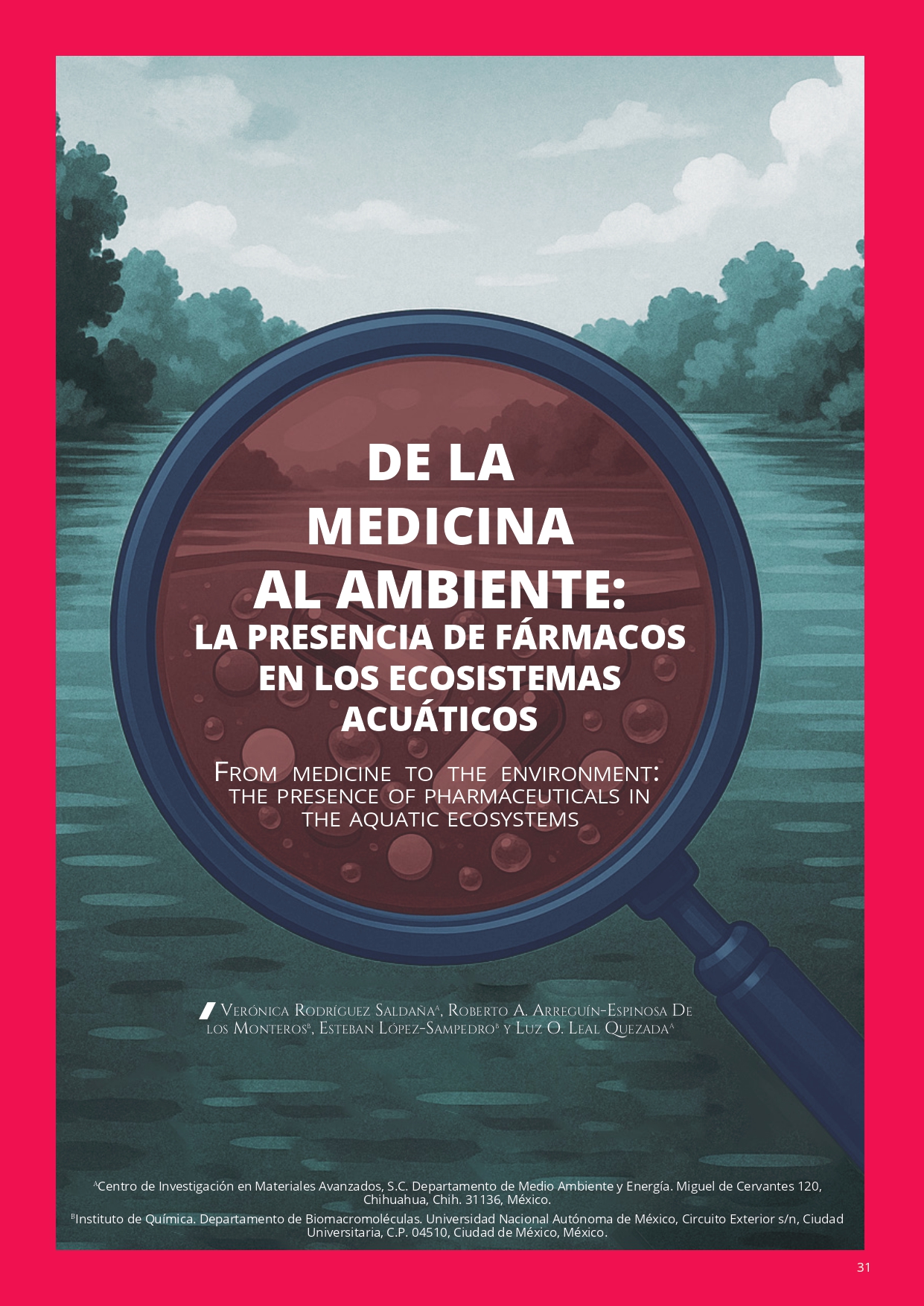
De la medicina al ambiente
la presencia de fármacos en los ecosistemas acuáticos
DOI:
https://doi.org/10.29105/bys9.17-224Keywords:
Pharmaceuticals, Pollution, Water bodies, Emerging pollutantsAbstract
Did you know that our pharmaceuticals can end up in rivers and oceans? From the toilet to the drain, these compounds reach treatment plants, and from there, they go into the environment. The presence of these drugs in water can affect fish and other aquatic organisms, altering their reproduction and development. The problem becomes even more complex when we add inappropriate consumer behaviours such as self-medication and a lack of regulation in over-the-counter medicines. However, it's not all bad news. New technologies are being developed for the removal of medications from wastewater, as well as strategies to prevent them from reaching the environment, and more information about this problem is becoming known and disseminated.
Downloads
References
Al Meslamani, A. Z., & Abdel-Qader, D. H. (2023). The abuse and misuse of over-the-counter medicines during COVID-19. Hospital Pharmacy, 58(5), 437-440. https://doi.org/10.1177/00185787231158777
Avetta, P., Fabbri, D., Minella, M., Brigante, M., Maurino, V., Minero, C., ... & Vione, D. (2016). Assessing the phototransformation of diclofenac, clofibric acid and naproxen in surface waters: model predictions and comparison with field data. Water research, 105, 383-394. https://doi.org/10.1016/j.watres.2016.08.058
Bavumiragira, J. P., & Yin, H. (2022). Fate and transport of pharmaceuticals in water systems: A processes review. Science of The Total Environment, 823, 153635. https://doi.org/10.1016/j.scitotenv.2022.153635
Becerril Ortiz, M. E., & Ramírez García, J. J. (2025). Review of physicochemical processes of naproxen and its byproduct toxicity in aquatic environment. Environmental Technology Reviews, 14(1), 781-796. https://doi.org/10.1080/21622515.2025.2545634
Belachew, S. A., Hall, L., & Selvey, L. A. (2021). Non-prescription dispensing of antibiotic agents among community drug retail outlets in Sub-Saharan African countries: a systematic review and meta-analysis. Antimicrobial Resistance & Infection Control, 10(1), 13. https://doi.org/10.1186/s13756-020-00880-w
Benites-Meza, J. K., Pinedo-Castillo, L., Cabanillas-Lazo, M., Boyd-Gamarra, M. A., Herrera-Añazco, P., Mougenot, B., & Benites-Zapata, V. A. (2025). Self-medication with NSAIDs and purchase of branded and over-the-counter medicines: Analysis of a national survey in Peru. Journal of Public Health Research, 14(1), 22799036251319154. https://doi.org/10.1177/2279903625131915
Chen, J., Wang, Y., Chen, X., & Hesketh, T. (2020). Widespread illegal sales of antibiotics in Chinese pharmacies–a nationwide cross-sectional study. Antimicrobial Resistance & Infection Control, 9(1), 12. https://doi.org/10.1186/s13756-019-0655-7
Church, N. A., & McKillip, J. L. (2021). Antibiotic resistance crisis: challenges and imperatives. Biologia, 76(5), 1535-1550. https://doi.org/10.1007/s11756-021-00697-x
Doomra, R., & Goyal, A. (2020). NSAIDs and self-medication: A serious concern. Journal of Family Medicine and Primary Care, 9(5), 2183-2185. https://.doi.org/10.4103/jfmpc.jfmpc_201_20.
Ebele, A. J., Abdallah, M. A. E., & Harrad, S. (2017). Pharmaceuticals and personal care products (PPCPs) in the freshwater aquatic environment. Emerging contaminants, 3(1), 1-16. https://doi.org/10.1016/j.emcon.2016.12.004
Fernandes, J. P., Almeida, C. M. R., Salgado, M. A., Carvalho, M. F., & Mucha, A. P. (2021). Pharmaceutical compounds in aquatic environments—occurrence, fate and bioremediation prospective. Toxics, 9(10), 257. https://doi.org/10.3390/toxics9100257
Frascaroli, G., Reid, D., Hunter, C., Roberts, J., Helwig, K., Spencer, J., & Escudero, A. (2021). Pharmaceuticals in wastewater treatment plants: A systematic review on the substances of greatest concern responsible for the development of antimicrobial resistance. Applied sciences, 11(15), 6670. https://doi.org/10.3390/app11156670
González Peña, O. I., López Zavala, M. Á., & Cabral Ruelas, H. (2021). Pharmaceuticals market, consumption trends and disease incidence are not driving the pharmaceutical research on water and wastewater. International journal of environmental research and public health, 18(5), 2532. https://doi.org/10.3390/ijerph18052532
Inefam. Tablero de indicadores de salud en México. (2024). Disponible en “Booklet” de Indicadores: Tablero-de-indicadores-S-FVv1.pdf (inefam.com). Consultado el 25 de junio, 2024.
Khan, A. H. A., & Barros, R. (2023). Pharmaceuticals in water: risks to aquatic life and remediation strategies. Hydrobiology, 2(2), 395-409. https://doi.org/10.3390/hydrobiology2020026.
Khan, S., Naushad, M., Govarthanan, M., Iqbal, J., & Alfadul, S. M. (2022). Emerging contaminants of high concern for the environment: Current trends and future research. Environmental Research, 207, 112609. https://doi.org/10.1016/j.envres.2021.112609.
Kózka, B., Sośnicka, A., Nałęcz-Jawecki, G., Drobniewska, A., Turło, J., & Giebułtowicz, J. (2023). Various species of Basidiomycota fungi reveal different abilities to degrade pharmaceuticals and also different pathways of degradation. Chemosphere, 338, 139481. https://doi.org/10.1016/j.chemosphere.2023.139481
Liu, X., Wang, Z., Zhang, L., Fan, W., Yang, C., Li, E., ... & Wang, X. (2021). Inconsistent seasonal variation of antibiotics between surface water and groundwater in the Jianghan Plain: Risks and linkage to land uses. Journal of Environmental Sciences, 109, 102-113. https://doi.org/10.1016/j.jes.2021.03.002
Llorens-Blanch, G., Badia-Fabregat, M., Lucas, D., Rodriguez-Mozaz, S., Barceló, D., Pennanen, T., ... & Blánquez, P. (2015). Degradation of pharmaceuticals from membrane biological reactor sludge with Trametes versicolor. Environmental Science: Processes & Impacts, 17(2), 429-440. https://doi.org/10.1039/C4EM00579A
Mackuľak, T., Černanský, S., Fehér, M., Birošová, L., & Gál, M. (2019). Pharmaceuticals, drugs, and resistant microorganisms—environmental impact on population health. Current Opinion in Environmental Science & Health, 9, 40-48. https://doi.org/10.1016/j.coesh.2019.04.002
Madikizela, L. M. (2021). Removal of organic pollutants in water using water hyacinth (Eichhornia crassipes). Journal of environmental management, 295, 113153. https://doi.org/10.1016/j.jenvman.2021.113153
Muñoz García, B. L. (2023). Automedicación y factores asociados en América Latina. Revisión Bibliográfica. https://doi.org/10.59590/upsjb/fcs.med.hum/tesis/4478
Ortiz, M. I., Flores-Ceron, K. I., & Muñoz-Pérez, V. M. (2022). Self-medication practice in Mexico. The Senior Care Pharmacist, 37(7), 266-283. https://doi.org/10.4140/TCP.n.2022.266
Pérez, D. J., Lombardero, L. R., & Doucette, W. J. (2023). Influence of exposure time, physicochemical properties, and plant transpiration on the uptake dynamics and translocation of pharmaceutical and personal care products in the aquatic macrophyte Typha latifolia. Science of The Total Environment, 896, 165107. https://doi.org/10.1016/j.scitotenv.2023.165107
Sanusi, I. O., Olutona, G. O., Wawata, I. G., & Onohuean, H. (2023). Occurrence, environmental impact and fate of pharmaceuticals in groundwater and surface water: a critical review. Environmental Science and Pollution Research, 30(39), 90595-90614. https://doi.org/10.1007/s11356-023-28802-4
Vinayagam, V., Murugan, S., Kumaresan, R., Narayanan, M., Sillanpää, M., Dai Viet, N. V., ... & Gadiya, S. (2022). Sustainable adsorbents for the removal of pharmaceuticals from wastewater: A review. Chemosphere, 300, 134597. https://doi.org/10.1016/j.chemosphere.2022.134597.
Zenker, A., Cicero, M. R., Prestinaci, F., Bottoni, P., & Carere, M. (2014). Bioaccumulation and biomagnification potential of pharmaceuticals with a focus to the aquatic environment. Journal of environmental management, 133, 378-387. https://doi.org/10.1016/j.jenvman.2013.12.017.
Downloads
Published
How to Cite
License
Copyright (c) 2026 Verónica Rodríguez Saldaña, Roberto Alejandro Arreguín-Espinosa De los Monteros, Esteban López-Sampedro, Luz Olivia Leal Quezada

This work is licensed under a Creative Commons Attribution 4.0 International License.